Why INT2ACT?
To me, DNA is far more than just a genetic blueprint. It can be synthesised and precisely engineered to carry a wide range of new functionalities, transforming it into a modular building block for bio-nanotechnology. This versatility opens up exciting possibilities across all areas of science.
The INT2ACT project gives me the opportunity to work within a vibrant, interdisciplinary community, applying our modified DNA to address urgent medical challenges—and helping to develop timely, meaningful solutions.
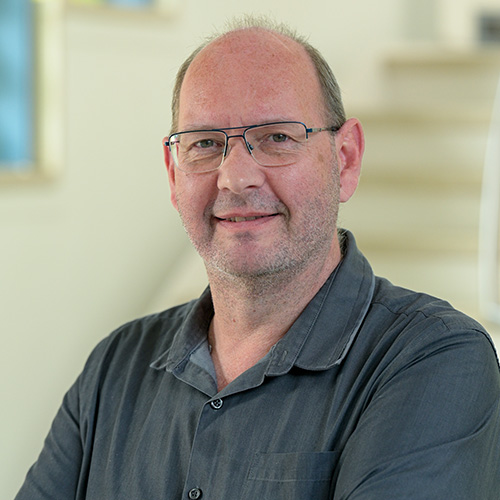

Prof. Eugen Stulz is an Associate Professor in Chemistry, focussing on medicinal aspects of modified DNA within the School of Chemistry and Chemical Engineering at the University of Southampton in the United Kingdom.
His group’s research is inherently interdisciplinary, bridging chemistry, biology, medicine, and chemical engineering. They focus on addressing major global challenges such as developing new strategies to combat cancer and advancing sustainable solutions for energy conversion. In INT2ACT, they harness their expertise in the synthesis of tailor-made DNA to design novel functional molecules with applications in sensing, diagnostics, and therapeutics.
Prof. Stulz also leads two thematically aligned initiatives, OLIGOMED and ON-TRACT, which aim to strengthen the scientific landscape in cancer research through collaboration and innovation.
For me, chemistry is the ultimate blend between theory and practice: hypotheses can be proven or disproven by scientific experiments, watching products form in front of your eyes. Working towards healthcare, and in particular cancer, has long been my goal for personal reasons, which is why this network is a very important part of my research and interest.
I earned my Ph.D. from the University of Bern in 1999, working on artificial nucleases based on zirconium(IV) complexes. I then joined the University of Cambridge as a Swiss National Science Foundation Fellow, focusing on supramolecular chemistry and dynamic combinatorial libraries involving phosphine-substituted porphyrins.
In 2003, I began my independent research at the University of Basel as a Lecturer with a Treubel Foundation Fellowship, developing DNA-based multiporphyrin arrays. I subsequently joined the University of Southampton in 2006, where I am now Associate Professor in Chemistry and focussing on medicinal aspects of modified DNA.
Wdowik, T., Fedorov, E., Ho, T. T., Duriez, P., Stulz, E. & Gryko, D. (2025) Red-Light-Induced Cysteine Modifications Suitable for Protein Labeling. ACS Org. Inorg. Au, 6. https://doi.org/10.1021/acsorginorgau.5c00025
Hannauer, F., Black, R., Ray, A. D., Stulz, E., Langley, G. J. & Holman, S. W. (2023) Review of fragmentation of synthetic single-stranded oligonucleotides by tandem mass spectrometry from 2014 to 2022. Rapid Commun. Mass Spectrom. 37, 20. https://doi.org/10.1002/rcm.9596
Kaur, B., Malecka, K., Cristaldi, D. A., Chay, C. S., Mames, I., Radecka, H., Radecki, J. & Stulz, E. (2018) Approaching single DNA molecule detection with an ultrasensitive electrochemical genosensor based on gold nanoparticles and cobalt-porphyrin DNA conjugates. Chem Commun 54, 11108-11111. https://doi.org/https://dx.doi.org/10.1039/c8cc05362f
Marth, G., Hartley, A. M., Reddington, S. C., Sargisson, L. L., Parcollet, M., Dunn, K. E., Jones, D. D. & Stulz, E. (2017) Precision Templated Bottom-Up Multiprotein Nanoassembly through Defined Click Chemistry Linkage to DNA. ACS Nano 11, 5003-5010. https://doi.org/https://dx.doi.org/10.1021/acsnano.7b01711