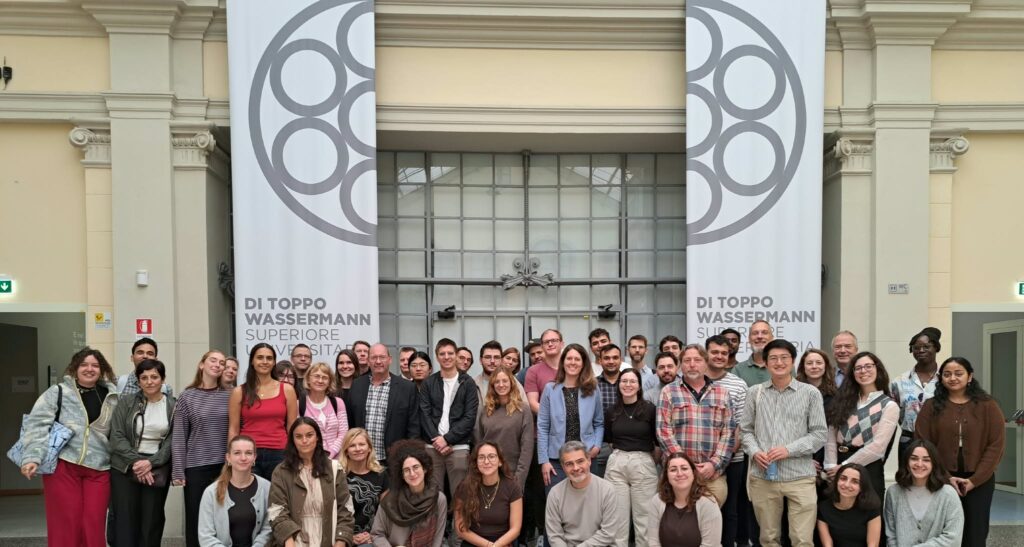
From 16 to 23 October 2026, INT2ACT doctoral candidates (DCs) gathered in Udine, Italy, for a joint meeting with the ON-TRACT doctoral network, followed by a series of training activities designed to strengthen their scientific knowledge, transferable skills and professional development.
Hosted at Palazzo di Toppo Wassermann by the University of Udine, the event provided opportunities for scientific exchange, interdisciplinary learning and networking among doctoral candidates, supervisors and researchers.The meeting and training activities were organised by Prof. Carlo Vascotto, INT2ACT Project Coordinator at the University of Udine, with the support of Veronica Bazzani and Petra De Lotto.
Connecting research and building collaborations
The meeting began on 16 October with an introduction to the INT2ACT and ON-TRACT projects. DCs and principal investigators (PIs) presented their research activities, providing an overview of the scientific objectives and approaches to be pursued across both doctoral networks. The programme also included introductory training on EU funding guidelines, project structure, roles, responsibilities and obligations, helping doctoral candidates better understand the requirements of Horizon Europe-funded research projects.
The following two days featured scientific sessions covering topics such as oligonucleotide chemistry, RNA modifications, biomarker discovery and personalised medicine. Presentations from invited researchers offered insights into emerging methodologies and applications, encouraging discussions across disciplines and highlighting potential synergies between the projects.
Beyond the scientific programme, informal exchanges and networking activities helped doctoral candidates establish connections with their peers and identify opportunities for future collaboration.


Developing essential skills for research and beyond
From 19 to 23 October, the focus shifted towards structured training activities addressing key competencies for doctoral researchers.
Three complementary training programmes were organised:
Science Communication, Ethics & Knowledge in the Digital Age, delivered by CESI, explored science communication, the relationship between science and society, research ethics, trust in science and the role of artificial intelligence in research and communication.
Sustainable Efficiency, delivered by Self Leaders, focused on personal effectiveness, decision-making, managing attention and maintaining sustainable working practices throughout a research career.
The Green Researcher, delivered by Green Vitàe, introduced sustainability principles, practical tools for greener research and approaches to integrating environmental considerations into scientific activities.
Through interactive sessions, practical exercises and group discussions, participants reflected on how these competencies can support both their doctoral research and their longer-term professional development.


A doctoral candidate’s perspective: Chang Liu
For Chang Liu, INT2ACT DC3 at the Institute of Bioorganic Chemistry, Polish Academy of Sciences, Poland, the meeting was an opportunity to broaden his scientific perspectives and strengthen his connections within the network.
Chang’s research focuses on the application of nanopore sequencing to investigate low-abundance RNA structures and explore their potential relevance to cancer biomarker discovery. His project aims to harness the technology’s ability to sequence RNA directly, distinguish transcript isoforms and preserve information about natural RNA modifications.
Reflecting on his first months in INT2ACT and his experience in Udine, Chang shared:
“What I have appreciated most about my first two months in INT2ACT is how welcome and supported my supervisor and colleagues have made me feel. Their guidance, together with reading and training, has helped me understand my project’s aims.
He particularly valued the opportunity to connect with fellow doctoral candidates during the event:
“The training event in Udine was a highlight. The lectures and training sessions introduced me to research and perspectives beyond my own project. I particularly enjoyed getting to know the other doctoral candidates. Everyone was friendly and welcoming, which made it easy to chat and exchange ideas. These conversations also helped me see how closely connected and complementary our projects are, opening up possibilities for future collaboration. I returned feeling motivated and look forward to staying connected and learning from others as our projects develop.”
Supporting the next generation of researchers
The Udine meeting highlighted the importance of combining scientific expertise with transferable skills, interdisciplinary collaboration and peer learning. By bringing together doctoral candidates from INT2ACT and ON-TRACT, the event created an environment for exchanging knowledge, developing professional competencies and establishing connections that can support future research.
As the INT2ACT doctoral candidates continue their projects across Europe, the knowledge and relationships developed in Udine will contribute to their growth as researchers and to the wider objectives of the doctoral network.